
DignArte Cimarrona: Seven Territories, One Memory That Comes Together and Transforms
By: Nayeli González F.
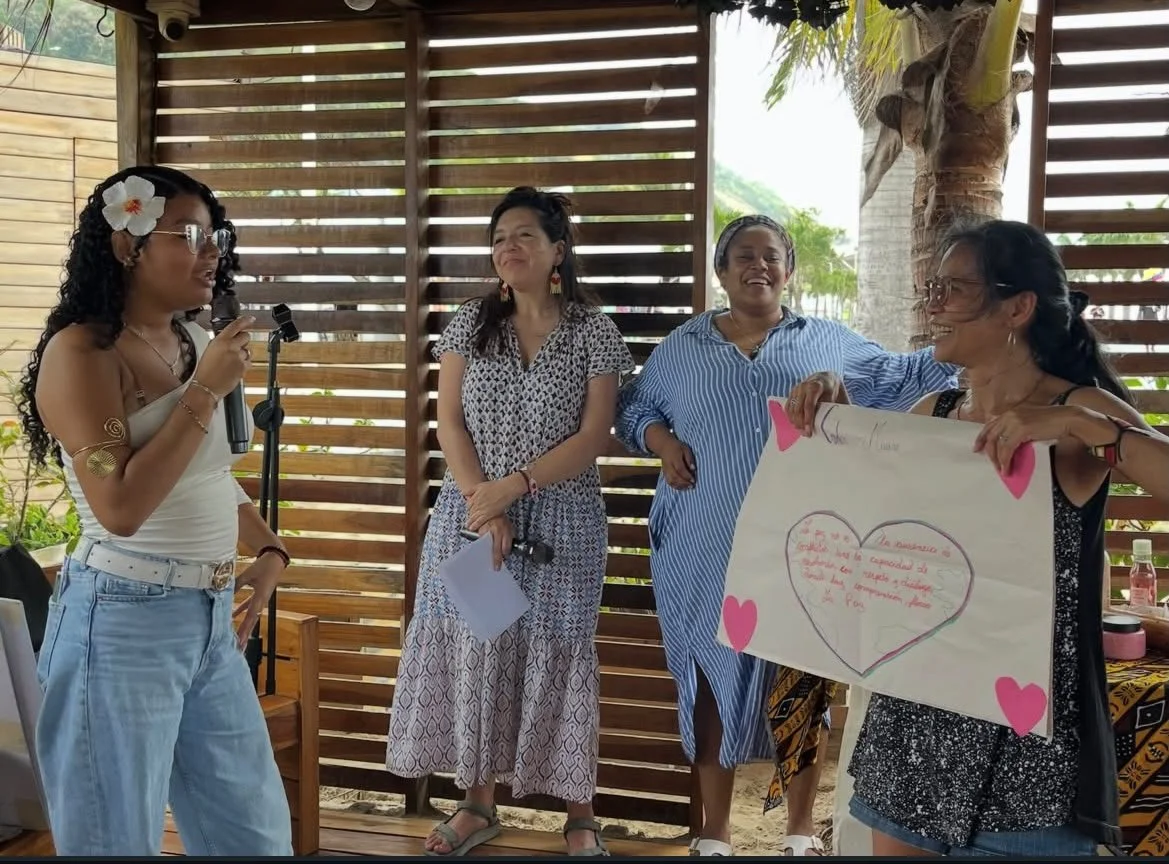
What happens when the stories of a territory are no longer held only in the memory of those who live them and find in art a way to be told, shared, and transformed? That was one of the questions that guided the DignArte Cimarrona Creative Laboratory, held from June 26 to 28 at the office of the Fundación de Acción Social e Integral Mujeres de Asfalto in Esmeraldas, where researchers from the seven cantons that are part of the process came together.
Over three days, voices, photographs, memories, and experiences gathered across the territories came together to take a new step: turning the cantonal research into exhibition experiences capable of speaking to their own communities and, subsequently, engaging in dialogue with other territories across the country.
The gathering also included the participation and support of Cristina Cielo, from the FLACSO team, and Sofía Zaragocin, from the University of Illinois team, who joined this process of exchange, reflection, and collective construction. The Creative Laboratory provided an opportunity to review the progress made in each canton, share the proposals developed, and work collectively on the conceptualization of the seven exhibitions.
Each territory arrived with its own story and a particular way of looking at its realities:
In Esmeraldas, Stories That Unite Us addresses gender-based violence, structural racism, exclusion, and collective memory, turning the city into a living archive where images speak of the experiences of women, adolescents, and LGBTIQ+ people.
In Rioverde, A Look at Territory, Identity, and Memory connects nature, Afro-descendant identity, culture, and community memory as expressions of resistance.
Quinindé presents Between Threads and Memories: Stories of Resistance and Reparation, where photographs transformed through embroidery become exercises in memory, reparation, and resistance in the face of racialized and gender-based violence.
In Muisne, The Territory Also Speaks intertwines gender-based violence with the social and environmental transformations of the territory and proposes imagining possible futures built through collective care.
Atacames, through Perspectives That Transform, focuses on forms of violence that often remain hidden behind the tourist landscape and opens a participatory space where the voices of those who visit the exhibition also become part of the narrative.
In Eloy Alfaro, Memories of the Sea, the Rivers, and the People recovers the memories, ancestral knowledge, cultural expressions, and forms of community organization of the communities in northern Esmeraldas.
And San Lorenzo, with Intervened Images, Living Identities, makes the creative process itself part of the exhibition, using art as a tool to question stereotypes, re-signify memories, and strengthen Afro-descendant pride.
Seven cantons. Seven perspectives. Seven ways of narrating the territory
But the laboratory made it clear that these exhibitions are not isolated stories. One of the main agreements reached during the gathering was to move forward with a schedule for the seven cantonal exhibitions, which will be presented in each of their respective territories. The intention is for each exhibition to preserve the voice, identity, and particularities of its canton while, at the same time, becoming part of a broader narrative.
For this reason, once the seven-exhibition journey is complete, a major DignArte Cimarrona collective exhibition is envisioned, bringing together the different themes, methodologies, and territorial experiences to construct a collective reading of the province of Esmeraldas.
This exhibition is projected to travel to Quito, Guayaquil, and, if possible, the Galápagos, taking the voices, memories, and experiences built in the territories beyond the province. The laboratory guide specifically contemplated the development of this collective exhibition, as well as the definition of its circulation and exhibition schedule.
Not Just to Show, but to Engage in Dialogue
The DignArte Cimarrona proposal also seeks to transform exhibitions into spaces for encounter. As part of the plans for the collective exhibition, the group proposed holding conversation panels with the researchers, where those who participated in the process can share their experiences, learnings, and reflections on the work carried out in their territories.
In this way, the exhibitions will not simply be spaces for looking at photographs or walking through installations. They will also be spaces to listen to those who conducted the research, walked through the territories, spoke with their communities, and built the stories that now take the form of an exhibition.
The DignArte Cimarrona Creative Laboratory concluded with concrete agreements regarding the exhibitions, their schedules, installation strategies, circulation, communication, and coordination with strategic allies. But above all, it left one certainty: the territory has much to tell when those who inhabit it have the opportunity to narrate it in their own voices. DignArte Cimarrona emerges precisely from this place: from the need to look, listen, remember, and create new ways of telling the realities of Esmeraldas.
“Because a photograph can hold a memory, an exhibition can make it visible, but when seven territories bring their stories together, memory becomes a collective voice, and that voice is only beginning its journey across the country.”
