What bodies are being subjected to violence in the territory of Esmeraldas?
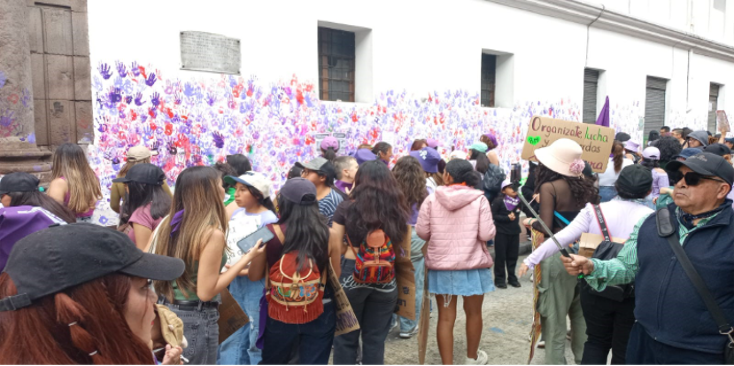
March 8th, hands that leave traces and voices that unite. Together, we transform silence into strength and memory into struggle. Photograph taken by the author
By Maria Preciado
In this blog post, Maria Preciado, DignArte Cimarrona researcher and member of the Mujeres de Asfalto Collective, analyses how violence is inscribed on bodies in Esmeraldas. Drawing on territorial history, lived experience, and interviews with key stakeholders working to prevent GBV in Esmeraldas, Maria explores which bodies are most exposed to violence and why. Rather than reducing Esmeraldas to violence alone, the analysis seeks to make visible both the harm done to, and the resistance carried out by, the local community:
Esmeraldas: territory of memory and multi-frontier
To feel Esmeraldas is to recognise what we inhabit, what we are. Being located on the northern coast of Ecuador allows us to understand ourselves not as an island, but as a multi-frontier: a territory historically shaped by inequalities, precarisation, and state absence, but also a space of resistance, ancestral memory, and community struggles.
In the national context, violence has reached historic levels. In 2025, Ecuador recorded 9,216 homicides, with a rate of 50.9 per 100,000 inhabitants, the highest in its history. By 2026, although a slight decrease has been recorded, the situation remains critical: between January and March 10, 1,642 homicides were counted, and in January alone there were more than 700 violent deaths.
This scenario disproportionately impacts territories such as Esmeraldas, where structural, armed, gender-based, and racist violence intersect, deepening the violation of rights among historically racialised populations.
Women and girls: the most exposed bodies
The bodies of women and girls in Esmeraldas continue to be the most violated. At the national level, in 2025 at least 349 femicides were recorded, that is, one woman killed every 22 hours.
Sexual violence also reflects alarming figures: 6 out of 10 women in Ecuador have experienced some form of violence throughout their lives. In contexts such as Esmeraldas, this reality is intensified by lack of access to justice, sexual and reproductive healthcare, and effective protection.
Many girls and adolescents continue to be victims of sexual violence, resulting in forced pregnancies that reveal not only direct aggression, but also the absence of the State in guaranteeing basic rights.
Children and adolescents: childhood at risk
Childhood in Ecuador faces an increasingly violent scenario. In 2023, at least 770 homicides of children and adolescents were recorded, and by 2026 the trend continues to rise, with a 5% increase in January, from 48 to 50 cases compared to the previous year.
These figures reflect the impact of organised crime on children’s lives, particularly in territories such as Esmeraldas, where forced recruitment, displacement, and armed violence have become part of everyday life.
Forced disappearances and extreme violence
Disappearances and extreme forms of violence continue to mark the territory. In recent years, dozens of cases of disappearances have been reported, some even linked to security operations.
Cases such as that of Cirilo Leonardo Minota, as well as those of young people found burned, reveal practices of violence that seek not only to take life, but to erase the identity of victims, deeply affecting their families and communities.
Unidentified bodies: lives erased
Violence is also expressed in nameless bodies. In Ecuador, the increase in violent deaths has led to a rise in unidentified corpses, many of them belonging to impoverished and racialised individuals.
In Esmeraldas, cases such as the discovery of women buried with signs of torture reflect a reality in which violence not only kills, but also renders invisible and denies the right to memory.
A territory that resists
Despite this context, Esmeraldas remains a territory of resistance. Social organisations, collectives of Afro-descendant women, youth, and human rights defenders continue to generate processes of accompaniment, denunciation, and community care.
These resistances confront not only direct violence, but also structural racism and the historical exclusion that have marked the territory.
Conclusion
In 2026, the most violated bodies in Esmeraldas continue to be those of women, girls, boys, adolescents, disappeared persons, and unidentified individuals. Violence manifests in multiple forms: homicides, femicides, sexual violence, forced recruitment, and disappearances.
However, in the face of this reality, resisting bodies also emerge: bodies that, through ancestral memory, community organisation, and everyday struggle, continue to defend the right to exist with dignity in a territory shaped by racism, inequality, and the historic absence of the State.